Prologue
In the midst of a blistering heat wave early in July of 1936 a number of people,
including the mayor of Gary, aviation historians and citizens of Miller Beach, gathered
in Marquette Park to dedicate a plaque to Octave Chanute and his gliding experiments
on the beach in 1896. Several people were there who remembered Chanute, remembered
that two weeks in late June of 1896 and the flights of the 'crazy old man of the
dunes.' While the memory was not fresh, it is certain that many of Miller's residents
in 1936 were aware that important experiments in the history of the development
of the airplane had occurred on their beach 40 years earlier. In the 60 years since
that time the significance and the memory of those glider flights has faded into
the past for almost all of Miller's residents.
The Significance of the Miller Experiments
Modern writers of aviation history recognize Chanute's experiments and their importance
to the development of powered flight. Histories of flight, like Dr. Tom Crouch's
A Dream of Wings or Fred Howard's biography Wilbur and Orville, give
extensive consideration to Chanute and his 'two-surface' glider - the glider that
inspired the Wright brothers in their construction of a bi-plane to be the vehicle
for man's first powered flight. Various air museums around the country and the world
proudly display replicas of Chanute's gliders, but perhaps Octave Chanute and Wilbur
Wright understood better than anyone the significance of the experiments on the
beach. In publishing the accounts of his experiments Chanute wrote:
"It may safely be asserted that more was learned concerning the practical requirements
of flight during the two weeks occupied by these experiments than I had gathered
during many previous years of study of the principles involved, and of experiments
with models"1
And of Chanute's contributions Wilbur Wright wrote in 1911:
"Mr. Chanute's...Dune Park2 experiments,
in combination with the clear manner in which they were presented to the public,
constituted another very important contribution, and finally his encouragement of
workers in all countries vastly influenced the trend of events accompanying the
birth of the art. From all of these causes I think I was fully justified in saying
that if he had not lived the history of human flight would have been quite different
from what it has been."3
1896: Flying Machines and Miller Junction
While it's not my intention to record the history of flight here, it is important
to look back on 1896 and the temper of those times, both nationally and locally.
Scientific discoveries of the 1800's were yielding a popular technology that was
putting man in the driver's seat, literally. In 1900 there were over 100 automobile
manufacturers in the state of Indiana alone. Inventors and 'tinkerers' were bustling
to strike it rich with all manner of mechanical devices. Many young men who were
flying kites and designing gliders were convinced it was only a matter of time before
man would learn to fly.
When a nineteen year old Augustus Moore Herring, Octave Chanute's chief collaborator
in 1896, was asked in 1884 by his father about a career choice he said "I'm
going to build an aircraft."4 So
when Chanute, Herring and several others disembarked at Miller Junction that June
22, 1896, they may have surprised the local residents with the machines they brought
for their experiments, but they were company to a great number of men around the
nation and the world with a similar ambition: to fly.
Miller Beach has been described as a 'sleepy' little community in 1896. How anyone
could depict a community composed mostly of Swedish immigrants as 'sleepy' is a
bit beyond me. They had built a church building in 1894. The students at Miller
School had won a world-wide competition at the Chicago Exposition three years earlier
with a display of the flora and fauna of the Indiana Dunes. The first gravel road
in Lake County was completed in 1896, stretching from Lake Station to the Grand
Calumet River in Miller over what is now Lake Street. The Hobart Gazette reported
at the end of August that a new, 200 foot wooden bridge across the Calumet River
north of Miller was complete, and
"...by those who have viewed it pronounced 1st class. It is what is called a pile
and bent bridge. A large sign conspicuous at Miller, which says, 'One mile north
to the proposed harbor'. It is only one mile from there to the lake but at present
a pretty sandy one."5
Excitement was evidently in the air and the area was on the verge of change, though
no one could have known that within 10 years the blast furnaces of a huge steel
plant would be built just to the west of Miller in a new town called Gary after
the chairman of United States Steel.
The Cast of Characters -
Octave Chanute (1832 - 1910)
Octave Chanute was a civil engineer, business man and aviation enthusiast whose
standing in the aeronautical world of the time was well established. In 1894 he
had published a compendium of articles, Progress in Flying Machines, which
quickly became the "bible" to a legion of aviation experimenters. He had
been researching and experimenting since the 1850's, and his library in Chicago
was probably one of the most complete on the subject of aeronautics in the world.
Born in Paris in 1832 he emigrated with his father in 1838 and was educated in private
schools in New York City. While never having had formal training as an civil engineer,
he nevertheless progressed through employment with various railroad companies to
become the chief engineer of the Chicago and Alton Railroad in 1863. After the Civil
War he designed and supervised the construction of the first railroad bridge over
the Missouri River at Kansas City. In the 1870's and 1880's he served as an engineering
consultant to the railroads which were spreading their tracks into the west and
spanning rivers with bridges. In 1890 he went into the business of railroad tie
preservation, a business that gave him enough financial security to be able to finance
experiments in aviation. He was a generous man who shared his knowledge and resources
with people who shared his dream of flight.
Augustus M. Herring (1865-1926)
Augustus Herring had dreamed of flying since he was a young boy. Born in 1865 to
a wealthy Georgia cotton merchant he had moved with his family to New York City
in 1883 and enrolled in the Stevens Institute of Technology. His thesis on "The
Flying Machine as an Mechanical Engineering Problem" was rejected as too fanciful
by the Institute and he left with no degree. In the early 1890's, living largely
on family trust money, he experimented extensively with gliders, flying in 1892
a curious bi-plane model powered by rubber strands. In New York he got the attention
of the press, and Octave Chanute, with some experiments with the German Otto Lilienthal's
successful gliders. 1895 was a busy year for the young man, working for Chanute,
then Samuel Langley at the Smithsonian, then back again with Chanute, who hired
him to help with the experiments he had planned for the summer of 1896 at Miller.
Herring was talented and independent, and as we shall see, contributed much to the
two-surface glider that was developed the following summer.
William Avery
William Avery was a Chicago carpenter and electrician. He was a long time associate
of Chanute, building the original multi-winged glider in his Chicago shop. He was
evidently an aviation enthusiast as well. He built the last copy of the 'Chanute
Double-Decker' and flew it at the St. Louis Exposition of 1904 in hopes of garnering
prize money for the longest glider flight. According to Tom Crouch, many years later,
Avery, "when applying for membership in the Early Birds, an organization for
pioneer pilots, he was asked to give the date and place of his first flight. He
proudly wrote: "Miller, Indiana - 1896."6
William Paul Butusov
The fourth, and perhaps most enigmatic of Chanute's group of experimenters was William
Paul Butusov. Originally a Russian sailor, he had dreamed of flying watching gulls
in flight. He approached a dubious Chanute with a story of having flown a large
manned glider in Kentucky in 1889, achieving flights lasting up to forty-five minutes.
He'd run out of funds to construct a new glider, but offered to work for Chanute
on his projects in exchange for the money to rebuild his Kentucky glider, which
he called the Albatross. His monetary needs were modest, and Chanute employed
the faithful and industrious Russian.
Butusov worked diligently on his machine, but it was not ready for the tests at
Miller in June of 1896. It was, however, a central feature of the tests at Dune
Park later that same summer. His Albatross, 40 feet in length with lifting
surfaces of 266 square feet, weighed 160 pounds without the operator, who was provided
with an 8 foot 'running board' below the wings to move around on to establish equilibrium.
A huge trestle was required to launch the craft and a great deal of time during
the second experiments at Dune Park was spent erecting the trestle and preparing
the Albatross for launching.
Interestingly the glider, which failed in its final tests in September, attracted
the most attention from the reporters who had gathered to watch the experiments.
No doubt because of its size and the elaborate trestle, the reporters focused on
the Albatross and generally missed the truly significant two-surface glider
that succeeded so well during the Dune Park experiments.
The First Experiments - Miller Beach, Indiana, June 22-
July 4, 1896
On June 22, 1896 Chanute and his three assistants climbed off the train at Miller
Junction with camping equipment, bringing also two gliders and a kite to experiment
with. They attracted a good deal of attention immediately, having to walk the mile
or so to the beach through downtown Miller. The first glider they tested was the
Lilienthal glider that Augustus Herring had modified to his liking. Otto Lilienthal
had attracted worldwide attention with his glider experiments in Germany in the
previous years, and Herring had attracted a good deal of attention in New York flying
variations of the Lilienthal glider. A number of flights, generally between 70 and
120 feet, were made with it until it was damaged beyond repair on June 29th.
Chanute didn't have much hope for the Lilienthal glider: "It is a gliding but
not a soaring mach[in]e and little is to be expected from it."7
The Multi-Winged Chanute Machine
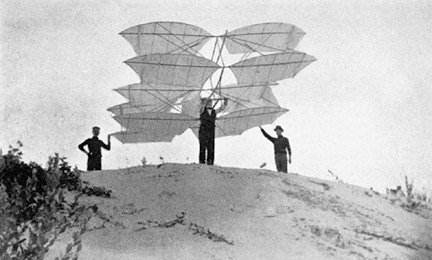
Chanute was interested in the other glider, the multi-winged machine that he had
been designing and building over the spring. This glider consisted of six pairs
of wings with a wingspan of twelve feet. It was truly an "experimental"
glider, designed so that the wing sections could be moved around and positioned
easily in different configurations. Perhaps the most abiding concern of glider experimenters
worldwide was that of equilibrium, not just distance. It was important to be able
to adjust to the shifts in the wind and sustain flight in different wind conditions.
The multi-winged machine was designed to experiment with these variables. Throughout
the course of his two weeks in Miller, Chanute almost daily changed the configuration
of the glider's wings and tail sections, often delighted with achieving better balance
with each and every try. On Saturday, June 27 he recorded in his diary:
"Rigged up machine with 4 wings in front & 8 behind.... Found this much easier
to handle than Lilienthal & more stable than any arrangement yet tried. ...Wind
too light for a full test, but experiment seems promising."
An eyewitness to the experiments, Joseph Conroy, speaking at the 1936 plaque dedication,
recalled Chanute's elation at the success of his experiments:
"'I've got it!' Conroy said Chanute cried repeatedly, jumping up and down in his
jubilancy over the successful flight."
8
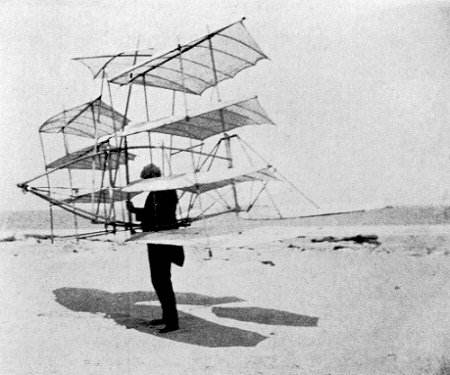 By Wednesday, July 1, the final configuration of the multi-winged machine had been
determined, putting 5 pair of wings in front and one behind. This was called the
Katydid, after the insect. A number of Katydid flights were taken
over the next few days, some of the more successful on the final day of the encampment
at Miller:
By Wednesday, July 1, the final configuration of the multi-winged machine had been
determined, putting 5 pair of wings in front and one behind. This was called the
Katydid, after the insect. A number of Katydid flights were taken
over the next few days, some of the more successful on the final day of the encampment
at Miller:
"Northerly wind, 6 to 13 miles an hour. Made a few jumps in forenoon-best one 55
ft. Wind freshened about noon and made a number of excellent jumps. Best one, Avery,
78 ft.; Herring, 82' 6". Quit at 2 P.M.. Packed up and went to Miller. Left
on 6:41 P.M. train, sending tent material home by express. Winged machine is more
compact and handy than Lilienthal's and it promises to be safer & steadier."
9
The Kite
The least documented, but perhaps the most significant experiment at Miller was
with a kite. Chanute mentions the "Herring kite" in his diary entries
of June 25 and 26th, and he took photos of Herring and Avery flying it.
It was a mono-winged kite with a fixed tail. Impressed with it's performance, Chanute
mentions that on the 26th they began construction of a new kite with a circular
frame for the wing. The success of this kite, coupled with fireside discussions
between Herring and Chanute, resulted in a completely new glider design in the encampment
on Miller Beach. Later Chanute would write that "While we were still in camp
I made and gave you [Herring], on cross-section paper, a sketch of the two-surfaced
machine with a Penaud tail to serve in building the 1896 machine."10 While Chanute and Herring would squabble in later years
over who contributed what to the design of the 'Chanute double decker' that would
have such an influence on the Wright brothers, the fact is that they returned to
the south shore of Lake Michigan six weeks after leaving Miller, and they brought
with them a radically different sort of glider built in those six weeks. It's safe
to assume that when they climbed on that 6:41 train back to Chicago on July 4th
that they were inspired not only by the success of their experiments but by the
prospects of building a totally new and potentially revolutionary glider.
The Second Experiments - Dune Park, August 21 - September
26, 1896
When Chanute and his party returned to Northwest Indiana on August 21st
they avoided Miller. The beach at Miller was much too accessible to reporters and
other visitors, being only a mile on good road from the rail junction. Also, since
they now would be bringing Butusov's Albatross and the materials needed to
construct the trestle launching way, it made more sense to come by boat. Accordingly,
they loaded the gliders and materials on the boat Scorpion on Thursday, August
20th and arrived off the Dune Park location the next day about noon.
No sooner had they offloaded the equipment and pitched their tent than a great storm
struck, scattering the camp equipment, blowing down the tent and smashing the wings
of the new "Herring machine". Bad weather, injuries, and squabbles would
plague the party over the next 37 days spent at Dune Park.11 The reporters found them anyway, cutting their way
through bug infested marshland from the Dune Park train stop to the experimenters
campsite.
It wasn't until Sunday, August 23rd that they had the camp back in order,
re-pitching the tent that afternoon. Herring had returned to Chicago to get new
spars for his smashed wings and wouldn't return until Wednesday. The first week,
evidently fairly decent weather, was spent erecting the trestle to launch the Albatross,
which was finished on Saturday, August 29th. That Saturday Herring tried the new
glider, first built as a three winged affair, with unsatisfactory results.
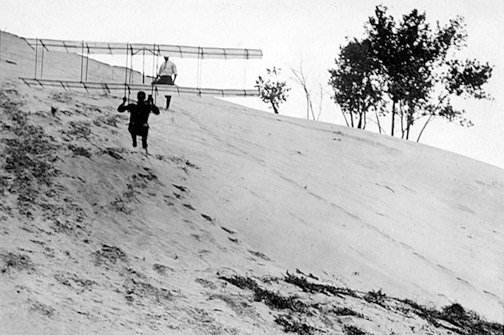 The next week saw only two decent days of weather. On Monday was the first flight
of the "double decker". At Avery's suggestion, they had removed the lower
wing of the three wing glider and were able to get a very good glide of 97 feet
in the new two surface machine. After three days of storms, Friday saw more good
efforts with the new glider, but it wasn't for another week, on Friday, September
11th, that the weather was good enough for the most successful glides
with the new, two surface glider and the rebuilt Katydid.
The next week saw only two decent days of weather. On Monday was the first flight
of the "double decker". At Avery's suggestion, they had removed the lower
wing of the three wing glider and were able to get a very good glide of 97 feet
in the new two surface machine. After three days of storms, Friday saw more good
efforts with the new glider, but it wasn't for another week, on Friday, September
11th, that the weather was good enough for the most successful glides
with the new, two surface glider and the rebuilt Katydid.
On that Friday the Katydid flew 188 feet and the new two-surface glider did
256 feet. On Saturday Herring, who was convinced that the Albatross was bound
to fail, refused to work on that machine and took the two surface machine for it's
most successful flight of 359 feet. Butusov's Albatross was put on the trestle
launching ways the next week and several unsuccessful attempts were made to fly
it as a kite. Another full week of bad weather went by until Saturday, September
26th, when there was another attempt to launch the Albatross.
According to Chanute's diary,
"As soon as the front of machine had fairly left the chute [the trestle],
the side wind blew the head around and the apparatus took a descending S.W. course,
describing a curved path. The left wing struck the trees west of chute, the tip
struck the sand and the wing was broken, this being chiefly in the main center arm.
The machine fell to the ground and a number of ribs and stanchions were broken."
With this it was determined to end this year's experiments and the party returned
to Chicago.
Epilogue - Writing and More Experimentation
Both Octave Chanute and Augustus Herring were inspired by the success of the new
two-surface glider, but in different ways. Chanute returned to his library in Chicago
to continue his writing. Eager to share his findings, the next year he published
a description of the experiments in James Means' Aeronautical Annual under
the title of Recent Experiments in Gliding Flight. Herring, for his part,
was convinced that the two surface glider was the answer to powered flight, and
that all that was necessary was to install a motor and propeller on the craft. Chanute
was dubious, believing that much more was left to be done with the problems of balance
and control. He was also out of funds with which to finance new experiments.
Herring continues...
Herring was undaunted. He returned to the Dune Park location the next month, October
of 1896, with a reconstructed three winged glider. The previous glider originally
had three wings, but one was mounted too low on the craft and had been removed.
Herring increased the surface lifting area of the craft from 134 square feet to
227 square feet by adding a third wing higher up and reported a successful glide
of 927 feet.12 The only evidence of
these experiments was from Herring himself, however, and some authors have claimed
that these flights never even took place.
Over the winter Herring found a new patron, Mathias Arnot of Elmira, N.Y., who was
willing to finance the construction of another glider almost identical to the original
two surface glider. He returned to Dune Park along with Arnot and several others
and continued the successful experiments with the glider, achieving a glide of 600
feet in September of 1897. Chanute was invited to those experiments and came, evidently
with his camera, for there are more good photos of the 1897 experiments than of
those the previous year. The gliders were so similar that Chanute used the 1897
photos to illustrate the experiments of 1896 in a lecture that he gave in October
of 1897 which was published in the Journal of the Western Society of Engineers.
Augustus Herring was intent on becoming the first man to fly. Over the winter he
moved to St. Joseph, Michigan, just across the lake from Chicago, and began work
on a larger bi-plane with a motor and propellers that he intended to fly on the
beach at St. Joseph. The problem of building a lightweight motor with enough power
to fly the craft was resolved with a compressed air motor that was charged at the
beginning of the flight and would only last a few minutes. Weighing 88 pounds with
the motor, Herring only accomplished two short flights with this machine in October
of 1898. Over the winter the machine was destroyed in a fire and Herring, for the
next several years, had to give up his aeronautical experiments.
Octave Chanute and the Wright Brothers
When the Wright brothers first became seriously interested in the problem of manned
flight in 1899 they wrote to the Smithsonian Institution and requested from it's
Secretary everything that had been written on the subject so far. From the materials
they received back from the Smithsonian it didn't take them long to realize that
Octave Chanute in Chicago had not only become the intellectual clearinghouse for
information about experiments worldwide, but highly successful experimenter in his
own right.
With that in mind, Wilbur Wright wrote Chanute asking for his advice in May of 1900.
With that began a decade long friendship and correspondence that numbered hundreds
of letters. The Wright-Chanute correspondence is considered to be one of the best
records of the Wright brothers experimentation and eventual success. Chanute visited
the Wrights on Kitty Hawk on several occasions, and was there in the weeks just
prior to the historic first flight in a powered airplane of December 17th,
1903. The Wright brothers, who experimented for three years at Kitty Hawk with gliders
before successfully adding a motor and propellers, had quickly adopted the trussed
bi-plane design that Chanute and Herring had developed on Miller Beach, but had
just as quickly surpassed Chanute in understanding how control, balance and equilibrium
were to be achieved in a craft in flight.
Ideas, and inventions, rarely spring from a single seed, but are like a garden,
an amalgamation of growth from different seeds. In the case of the airplane, one
of those seeds was planted on Miller Beach with the flying of a kite, and the design
of a glider sketched on paper.
1Octave Chanute, "Recent Experiments
in Gliding Flight", published in James Means,
Aeronautical Annual, 3
(Boston,1897) p 37
 2
2
Throughout
this essay, and in Chanute's writings, the location of the second experiments is
called "Dune Park". It is difficult to locate the exact location of these
experiments on the lake, but it's generally believed that they were on land now
occupied by Midwest Steel just east of Odgen Dunes. The name "Dune Park"
was the name of a stop on the now defunct Lakeshore and Michigan Southern Railroad.
It should not be confused with the current day Dune Park stop on the South Shore
Railroad that is just east of the Indiana Highway 49.
3Wilbur Wright to Charles S. Strobel,
January 27, 1911, in McFarland, Marvin D., The Papers of Wilbur and Orville Wright.
Vol II, pp 1018-1019.
4Quoted in Inglis, William, 'The Problem
of Flight Solved' (Harpers Weekly, October 24, 1908, p 27)
5Reported in the Westchester Tribune, Aug. 29, 1896, (Chesterton
Library). The bridge must have been interesting to the experienced engineer Chanute.
It was no doubt also a contributing factor to avoiding Miller later that summer.
The milages quoted here may be a bit confusing. For the record it is a mile from
the intersection of Miller Ave. and Lake Street, (downtown Miller) to the lake over
the bridge which is about three tenths of a mile from the lake.
6Crouch, Tom D.
A Dream of Wings, Americans and the Airplane, 1875-1905; (W.W.Norton
& Co., NY, 1981) p. 306.
7Chanute's Diary entry for June 23.
8Gary Post Tribune, July 13, 1936.
9Chanute's Diary entry for July 4, 1896.
10Letter from Chanute to Herring,
March 24, 1901, quoted in McFarland, Marvin D., The Papers of Wilbur and Orville
Wright. Vol II.
11Chanute's and his party spent 32
days at Dune Park, not counting Sundays, on which they did not work. Of the 32 days,
18 were unproductive due to weather conditions and only a little could be done,
and on one other, labeled an 'Indian Summer' day, there was no wind. Many of the
18 'good' days were spent constructing the Albatross. Overall there were only about
six days in that period were both machines and weather were conducive to gliding
experiments.
12Herring, A.M. "Recent
Advances toward a Solution of the Problem of the Century."
Aeronautical Annual,
3 (Boston, 1897), pp 70-74.